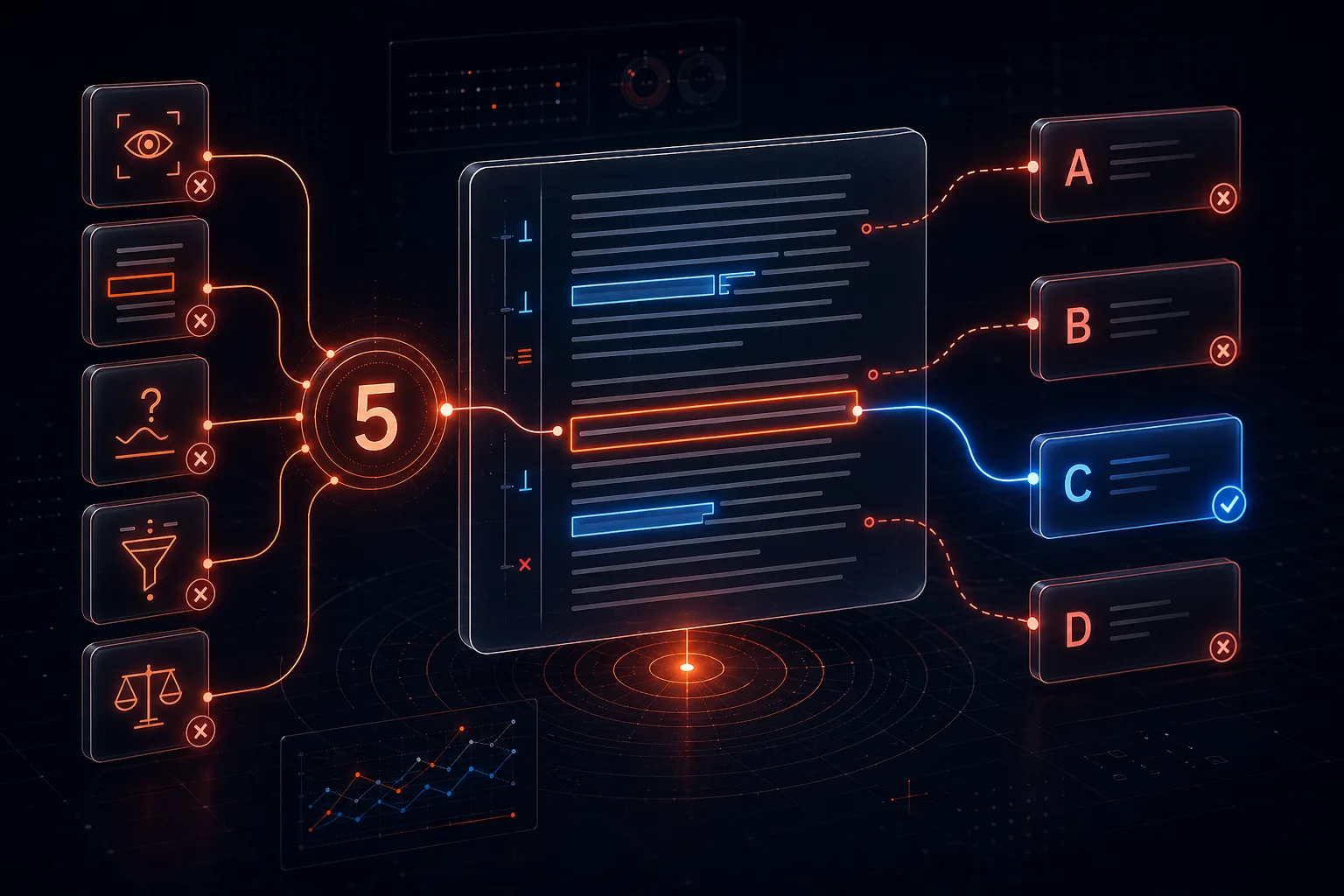
The 5 Most Common SAT Reading Mistakes (And How to Fix Them)
Reading & Writing is the section where students most often think they "just need more practice." They do timed passages, check answers, feel frustrated — and repeat. The problem is that random repetition doesn't fix specific error patterns. Let's look at the five most common ones.
Mistake #1: Reading Too Much of the Passage
The Digital SAT doesn't reward comprehensive reading. It rewards targeted reading. Most questions on the Reading & Writing section can be answered by reading 3–6 sentences around the cited line — not the full passage.
Students who read the entire passage before answering questions spend 40+ seconds per question on average just in reading time. This leaves almost no time for thinking through answer choices.
Fix: Practice "anchor reading." Read the question first. Identify the cited line or the key term. Read only the sentence before, the cited sentence, and the sentence after. Answer based on that. Go back only if the question explicitly requires broader context.
Mistake #2: Choosing "Too Extreme" Answers
SAT answer choices fall on a spectrum from extreme to neutral. Wrong answers on inference and main idea questions are often either too strong ("the author believes all scientists are wrong") or too specific ("the author describes three experiments proving X").
The correct answer is almost always the most restrained, evidence-backed interpretation.
Fix: When you're torn between two answers, ask: "Does the passage actually say this, or am I inferring more than the text supports?" The SAT rewards close reading, not interpretation.
Mistake #3: Not Knowing Transition Words
Transition questions are among the most common question types on the Digital SAT — and among the easiest to get right consistently once you understand them. The question gives you a sentence, a blank, and asks which transition word logically connects the ideas.
Students who miss these questions usually try to "feel out" which word sounds right. That doesn't work reliably.
Fix: Build a mental map of transition categories:
- Contrast: however, nevertheless, in contrast, yet, whereas
- Addition: furthermore, moreover, in addition, also
- Causation: therefore, consequently, as a result, thus
- Concession: although, even though, while, despite
When you see a transition question, classify the relationship between the ideas first (contrast? addition? causation?), then pick the word that matches the category.
Mistake #4: Ignoring the "Notes" in Vocabulary-in-Context Questions
Vocabulary questions on the SAT are NOT asking you for dictionary definitions. They're asking which word best fits the specific meaning in that specific context.
Students who select the most common definition of a word without reading the surrounding context almost always get these wrong.
Fix: Cover the answer choices before reading the passage sentence. Read the sentence and predict the meaning yourself. Then look at the choices and find the one that matches your prediction. This prevents the most common definition bias.
Mistake #5: Guessing on Rhetorical Purpose Questions Without a Strategy
"What is the main purpose of this paragraph?" is one of the most frequently missed question types. Students either overthink it or guess randomly.
Fix: Rhetorical purpose questions have predictable answer structures:
- To introduce → sets up a topic or question
- To illustrate → gives an example of a claim
- To contrast → shows an opposing view
- To qualify → adds a limitation or exception
- To conclude → wraps up or draws a conclusion
Read the paragraph. Ask: what job is this paragraph doing in the larger argument? Then match the job to the answer choice language.
Reading & Writing accuracy rarely comes from reading more passages. It comes from understanding these error patterns and drilling them specifically until the correct approach is automatic.
More from the Blog


SatSpike builds a personalized study plan around your specific weak spots — not generic prep.