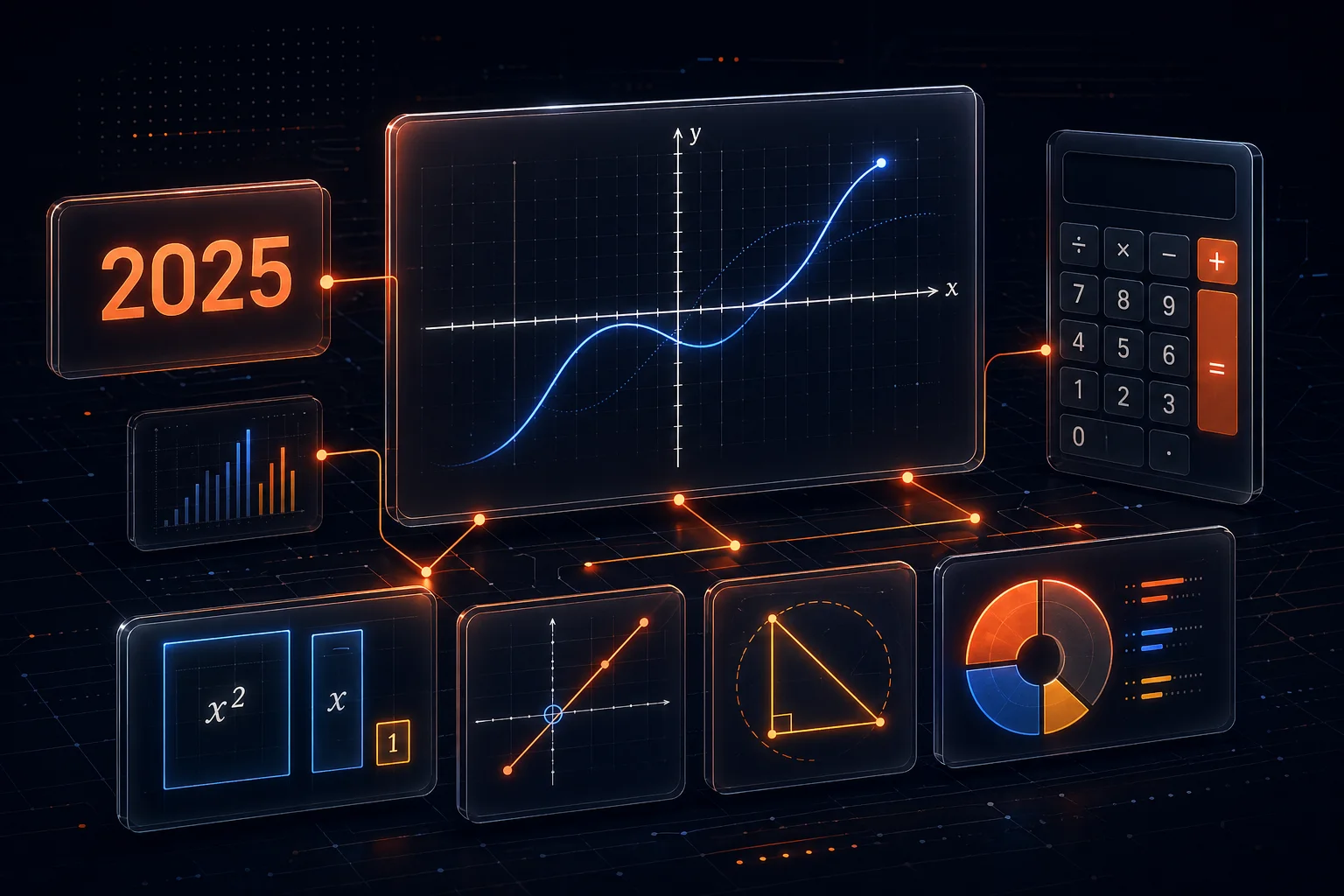
The Digital SAT Math section is not just the old SAT Math on a computer. The format, emphasis, and question distribution have changed meaningfully. Students who prep with old materials or assume the skills translate directly often encounter surprises on test day.
Here's what actually changed and what it means for your preparation.
What Changed: The Short Version
- Fewer questions, same time. 44 questions total, 70 minutes. (Old SAT had 58 questions in 80 minutes.) The per-question time increased slightly.
- Calculator allowed throughout. No more no-calculator section. You can use a calculator on every math question.
- More advanced algebra and data analysis. The Digital SAT skews harder in certain areas than the old test.
- More word problems. Applied math — setting up equations from real-world scenarios — is heavily emphasized.
The Four Domains and Their Weight
The Digital SAT Math section covers four content areas:
| Domain | Approx. Questions |
|---|---|
| Algebra | 13–15 |
| Advanced Math | 13–15 |
| Problem-Solving & Data Analysis | 5–7 |
| Geometry & Trigonometry | 5–7 |
Algebra is the largest domain. Linear equations, systems of equations, and linear inequalities dominate. If your algebra fundamentals are shaky, this should be your first priority.
Advanced Math covers nonlinear functions: quadratics, polynomials, exponentials. This is where many students who were strong on the old SAT find the Digital SAT harder.
The Calculator Myth
Many students assume that calculator access means math skills matter less. This is wrong.
The questions are designed so that brute-force calculation doesn't help much. The challenge is usually in setting up the equation, interpreting what the problem is asking, or recognizing the pattern — not in the arithmetic. A student who doesn't understand what "systems of equations" means won't be saved by a graphing calculator.
That said, the calculator is genuinely useful for:
- Checking arithmetic on multi-step problems
- Graphing functions to find intersections visually
- Evaluating expressions quickly
Use it strategically, not as a crutch.
The High-Priority Skills for 2025
Based on the current Digital SAT structure, these skills have the highest frequency and highest impact:
Tier 1 (must-master):
- Linear equations in one variable
- Linear equations in two variables / systems
- Interpreting linear functions and graphs
- Quadratic equations (factoring, quadratic formula)
- Exponential functions (growth/decay)
Tier 2 (important):
- Ratios, rates, proportional reasoning
- Percentages and percent change
- Statistics: mean, median, spread, interpreting tables
- Function notation and transformations
Tier 3 (worth knowing):
- Circles (area, circumference, arc length, sector area)
- Right triangles (Pythagorean theorem, basic trigonometry)
- Volume formulas
Most students spend too much time on Tier 3 material because it "feels like math class." But the test is heavily weighted toward Tier 1 and 2.
The Word Problem Challenge
Perhaps the most underappreciated change in the Digital SAT is the shift toward applied word problems. A question that tests "linear equations" on the Digital SAT often looks like:
"A plumber charges a flat fee of $80 plus $45 per hour for a service call. If the total charge for a service call was $260, how many hours did the service call last?"
The skill being tested is algebra — but the challenge is translating English into an equation. Many students who can solve linear equations from a clean algebraic setup struggle with word problems.
Fix: Practice the translation step explicitly. Given any word problem, before touching the math, write down:
- What is the unknown? (Let x = ...)
- What equation does the problem describe?
Once the equation is set up correctly, solving it is usually straightforward.
What This Means for Your Study Plan
If you're using old SAT prep materials (pre-2024), be aware that some material is outdated and some emphasis has shifted. The core math skills still apply, but:
- Do more applied/word problem practice than old materials emphasize
- Spend more time on functions (linear, quadratic, exponential) than on trigonometry
- Don't skip advanced algebra — it's heavier on the Digital SAT than many students expect
More from the Blog
SatSpike builds a personalized study plan around your specific weak spots — not generic prep.